
Direct answer
When BTC rises from 50,000 to 50,500 USDT (+1%), a 0.2 BTC long nets 89.95 USDT after 10.05 USDT of taker fees. At 10x the margin is 1,000 USDT and the return on margin is +9.00%, not +10%; at 5x it is +4.50% and at 20x +17.99%. On a 1% fall instead, the 10x return is −11.00%: on the same move, fees enlarge the loss more than they trim the gain.
The result first
Assume a long of 0.2 BTC bought at 50,000 USDT — 10,000 USDT of notional — with taker fills at 0.05% on both the opening and the closing trade. The price rises to 50,500 USDT, a move of +1%.
The price move earns 100.00 USDT; fees are 5.00 to open plus 5.05 to close, 10.05 USDT in all; the trade nets 89.95 USDT. At 10x the margin is 1,000 USDT, so ROE = 89.95 ÷ 1,000 = +9.00%.
Run the same trade at 5x and 20x and the net PnL is identical; only the margin changes. At 5x the margin is 2,000 USDT and ROE +4.50%; at 20x it is 500 USDT and ROE +17.99%. Changing only the leverage field in the futures PnL calculator shows all three.
How ROE is calculated
ROE (return on equity, here return on margin) = net PnL ÷ initial margin, and initial margin = notional ÷ leverage. So ROE = net PnL × leverage ÷ notional: leverage multiplies the return on notional as it stands.
After fees, the return on notional is only 89.95 ÷ 10,000 = 0.8995%. Multiplied by 10 that becomes the ROE. Opening plus closing fees cost about 0.10% of notional, and after the leverage multiplier that takes roughly one percentage point off the ROE.
An exchange's position screen usually shows unrealized PnL and a return figure; the latter is mostly this margin-based ROE. Before you close, the figure shown generally excludes the closing fee, so what lands in the account is slightly less.
Leverage against ROE
The same 0.2 BTC long from 50,000 to 50,500 USDT nets 89.95 USDT at every leverage; leverage only changes the margin, so ROE scales in proportion.
| Leverage | Initial margin (USDT) | Net PnL (USDT) | ROE |
|---|---|---|---|
| 1× | 10,000 | 89.95 | +0.90% |
| 3× | 3,333.33 | 89.95 | +2.70% |
| 5× | 2,000 | 89.95 | +4.50% |
| 10× | 1,000 | 89.95 | +9.00% |
| 20× | 500 | 89.95 | +17.99% |
| 50× | 200 | 89.95 | +44.98% |
Up and down moves at 10x
At a fixed 10x, the ROE for equal rises and falls. Fees shift every row down by about one percentage point: a 2% rise earns +18.99%, while a 2% fall costs −20.99%.
| Exit (USDT) | Price move | Net PnL (USDT) | ROE |
|---|---|---|---|
| 49,000 | −2% | loss 209.90 | −20.99% |
| 49,500 | −1% | loss 109.95 | −11.00% |
| 49,750 | −0.5% | loss 59.98 | −6.00% |
| 50,250 | +0.5% | gain 39.98 | +4.00% |
| 50,500 | +1% | gain 89.95 | +9.00% |
| 51,000 | +2% | gain 189.90 | +18.99% |
ROE in one line
ROE = leverage × [price move − opening fee rate − closing fee rate × (1 + price move)], leaving funding aside. At 10x, +1% and 0.05% taker fees: 10 × (1% − 0.05% − 0.05% × 1.01) = 8.995%, which the calculator rounds to +9.00%.
The formula shows two things: leverage multiplies the fees, and the smaller the move, the larger the fees' share. A swing aimed at 0.5% returns only +4.00% at 10x — a fifth of it taken by fees.
What maker fills change
With maker fills at 0.02% on both trades, the same 1% move costs only 4.02 USDT in fees and nets 95.98 USDT — an ROE of +9.60% at 10x. Against +9.00% with taker fees, the gap of 0.6 percentage points is exactly the fee difference times the leverage.
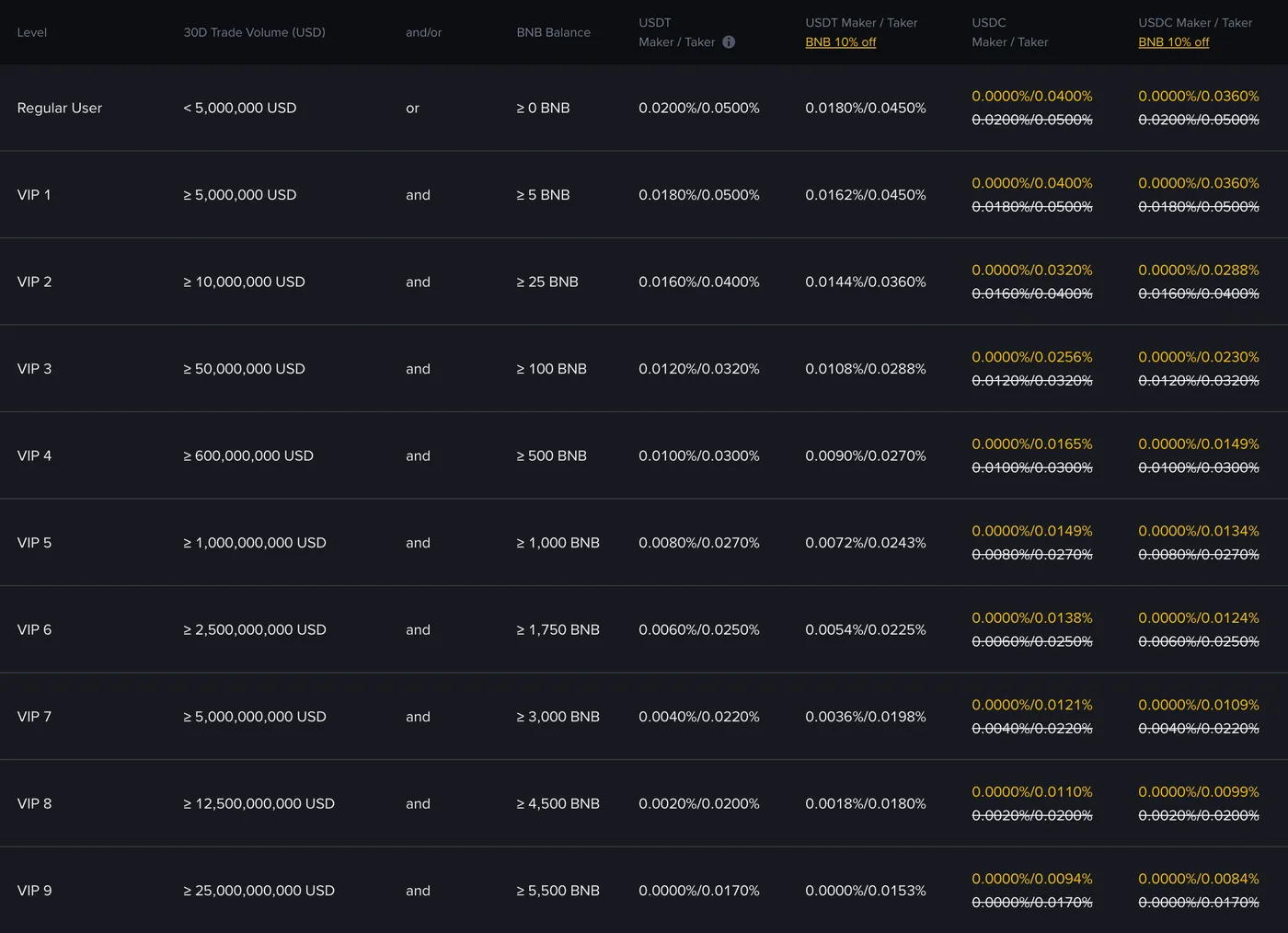
Fee tiers are listed on each exchange's fee page; below is Binance's official USDⓈ-M futures table, where the Regular User row shows the 0.0200%/0.0500% used in this article.
Why a 1% fall costs more
At 49,500 USDT (−1%) the price move loses 100.00 USDT and fees add 9.95 USDT, a net loss of 109.95 USDT. That is −11.00% at 10x and −21.99% at 20x. Fees are paid whether you win or lose, so they reduce gains and deepen losses.
This is what short-swing strategies most often overlook: every trade's outcome is shifted down by about 0.10% of notional, and once multiplied by leverage, that is a large fixed cost against the margin.
Before deciding by ROE
A higher ROE does not mean more money earned. On the same trade, 20x shows twice the ROE of 10x, yet earns exactly the same USDT while carrying far more liquidation risk. Compare strategies by net PnL in USDT and the largest possible loss.
Before ordering, check your fee tier on the exchange: VIP tiers or a platform-token discount change the rate, and the ROE with it. The calculator takes separate opening and closing fee rates for maker and taker combinations.
Official sources and calculation boundary
Return on margin uses initial margin as the denominator and fees follow executed notional, per OKX's futures PnL rules and Binance's fee documentation. An exchange's on-screen return may use the mark price and exclude the closing fee, so it differs slightly from the realized ROE here.
Open the matching calculatorNext checks in this series
Frequently asked questions
Does 10x leverage on a 1% rise always earn 10%?
No. After opening and closing fees this example earns +9.00%; the higher the fee rate and the leverage, the wider the gap.
Which matters more, ROE or the USDT result?
They answer different questions. ROE shows how efficiently the margin was used; the USDT figure is the money actually made. Change the leverage on the same trade and ROE changes while the USDT result does not.
Why does the exchange's return differ from the calculator?
An exchange's unrealized return usually excludes the closing fee and may use the mark price. Enter the mark price as the exit and add the closing fee rate, and the two converge.
Does higher leverage make fees more expensive?
Not in USDT — fees follow the notional. But their share of the margin grows with leverage, so their effect on ROE is larger.