
Direct answer
Buying 0.2 BTC at 50,000 USDT with 0.05% taker fees on both sides, price must reach 50,050.03 USDT (about +0.10%) to break even; with 0.02% maker fees on both sides, 50,020.00 USDT is enough. Held for one day through three funding settlements at +0.01%, the break-even price rises to 50,065.03 USDT; held for 30 days (90 settlements), it needs 50,500.25 USDT, a rise of about 1.00%.
The result first
Assume a long of 0.2 BTC bought at 50,000 USDT (10,000 USDT of notional) at 10x. With taker fills at 0.05% on both trades, the futures PnL calculator shows a break-even price of 50,050.03 USDT, about 0.10% above entry.
If both trades are maker fills (limit orders that rest on the book) at 0.02%, the break-even price is only 50,020.00 USDT. Opening as maker and closing as taker gives 50,035.02 USDT. On the same trade, how you place the orders more than doubles or halves the distance to break even.
Set the exit price equal to the entry (50,000 USDT) and the calculator shows the net loss at that point — 10.00 USDT with taker fees, 4.00 USDT with maker fees. That is what the trade has to earn back before it breaks even.
How the break-even price is calculated
A long's net PnL = (exit − entry) × quantity − entry × quantity × opening fee rate − exit × quantity × closing fee rate − funding. Setting it to zero and solving for the exit gives: break-even = [entry × (1 + opening fee rate) + funding ÷ quantity] ÷ (1 − closing fee rate).
With 0.05% taker fees: 50,000 × 1.0005 ÷ 0.9995 = 50,050.03 USDT. The (1 − closing fee rate) in the denominator reflects that the closing fee is charged on the exit price: the higher the price, the larger the fee, so break-even lands a touch above "entry plus two fees".
A short reverses the direction: break-even = [entry × (1 − opening fee rate) − funding ÷ quantity] ÷ (1 + closing fee rate). The same 0.2 BTC short at 0.05% taker needs the price to fall to 49,950.02 USDT to break even.
Fee rate against distance to break even
The same 0.2 BTC long with only the fee rate changed: the break-even price and the net loss when closing at the entry price. 0.036% and 0.040% stand for example lower fee tiers; your actual tier is the one in your account.
| Fee rate (both sides) | Break-even (USDT) | Rise needed | Net loss at entry price (USDT) |
|---|---|---|---|
| 0.020% | 50,020.00 | 0.04% | 4.00 |
| 0.036% | 50,036.01 | 0.07% | 7.20 |
| 0.040% | 50,040.02 | 0.08% | 8.00 |
| 0.050% | 50,050.03 | 0.10% | 10.00 |
Holding time against distance to break even
With 0.05% taker fees and funding at +0.01% every eight hours, the longer you hold, the more funding accumulates and the further break-even moves. At 30 days funding is 90.00 USDT — nine times the 10.00 USDT of fees.
| Held for | Funding settlements | Funding (USDT) | Break-even (USDT) |
|---|---|---|---|
| No settlement | 0 | 0.00 | 50,050.03 |
| 1 day | 3 | 3.00 | 50,065.03 |
| 7 days | 21 | 21.00 | 50,155.08 |
| 30 days | 90 | 90.00 | 50,500.25 |
Shorts have a break-even line too
A short's break-even price sits below entry. For the 0.2 BTC short with 0.05% taker fees it is 49,950.02 USDT; with funding at +0.01% held for one day, the short receives 3.00 USDT and break-even becomes 49,965.02 USDT, easier to reach than with fees alone.
In other words, the sign of the funding rate decides whether it raises the long's or the short's starting line. A glance at the current rate before holding keeps this cost from being missed.
Where the rates come from
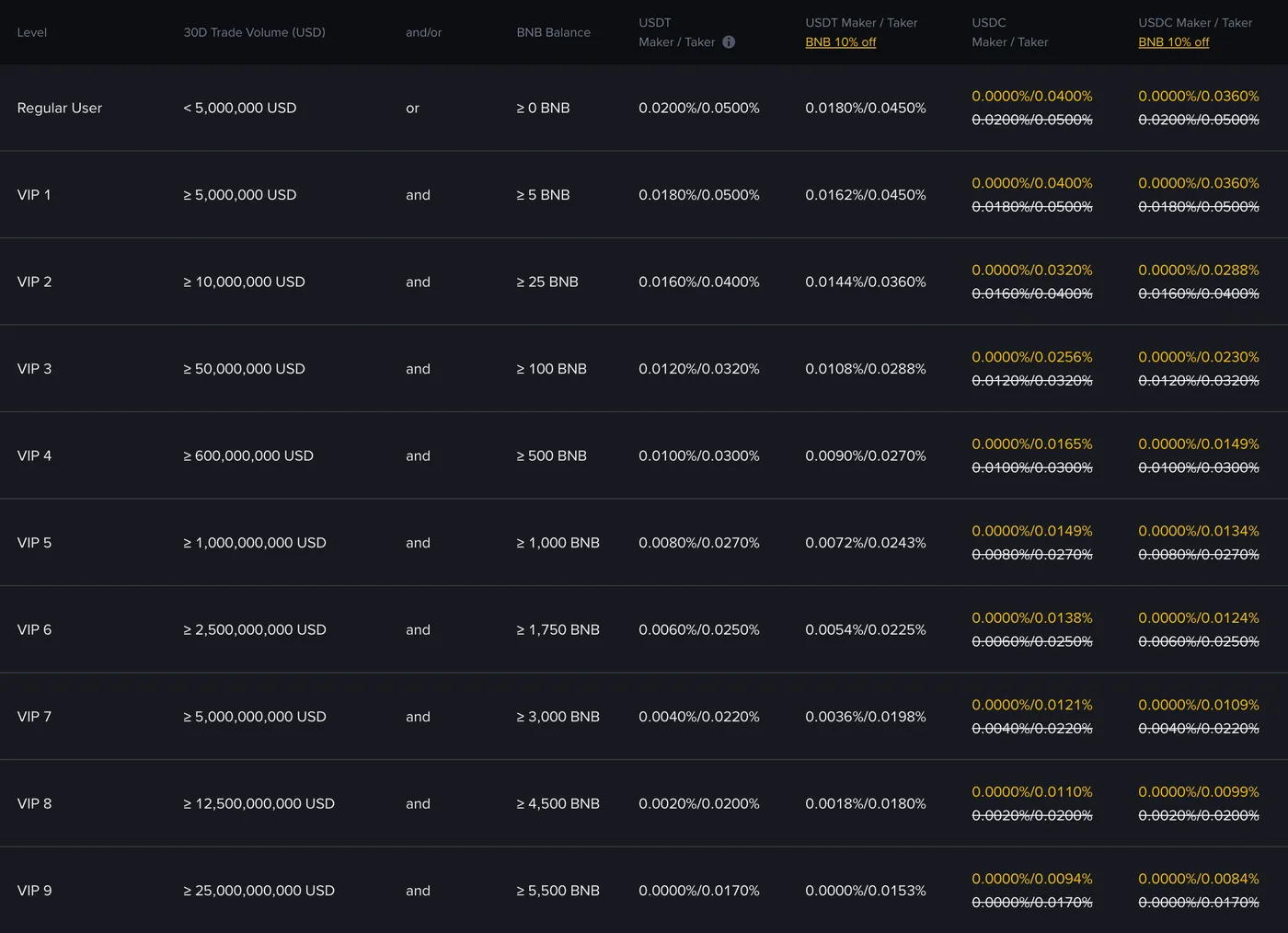
The 0.05% and 0.02% used here are the Regular User taker and maker rates for USDT-margined futures on Binance and OKX. Below is a screenshot of Binance's official fee table; its figures are as of the date shown, so confirm your own tier on the official page before ordering.
The longer you hold, the further away it gets
Funding accumulates with each settlement while the position is open. At +0.01% every eight hours, one day means three payments, 3.00 USDT in all, and the break-even price rises to 50,065.03 USDT; seven days (21 settlements) cost 21.00 USDT and move it to 50,155.08 USDT.
Over 30 days (90 settlements) funding reaches 90.00 USDT — more than the fees — and the break-even price becomes 50,500.25 USDT, a rise of about 1.00%. A higher funding rate stretches this distance proportionally; a negative rate pays the long instead and moves break-even down.
How to use the figure
Treat the break-even price as the floor under a take-profit. If the expected move is only slightly larger than the distance to break even, fees and slippage can absorb the whole edge. Short-term trades especially should target a move several times the break-even distance.
Real fills also carry slippage: a market order often fills a tick or two worse than the price on screen, which pushes break-even further out. Recalculate with your expected fill as the exit, and confirm your actual fee tier on the exchange before ordering.
Official sources and calculation boundary
Fees on each trade's executed notional follow Binance's fee documentation; the direction and settlement of funding follow OKX's funding FAQ. +0.01% every eight hours is an example; the actual rate and interval are the ones on the exchange's page.
Open the matching calculatorNext checks in this series
Frequently asked questions
Why isn't break-even simply entry plus 0.10%?
It is very close, but the closing fee is charged on the exit price, which is higher, so the exact figure is 50,050.03 USDT — slightly above 50,050.
Are maker orders always better?
Maker fees are lower — in this example they cut the break-even distance from about 0.10% to 0.04% — but a resting order may not fill, and a missed move has its own cost.
Can funding lower the break-even price?
Yes, when you are the side receiving it. With a negative rate the long is paid and its break-even moves down; with a positive rate the short is paid and its break-even moves up.
Is this the same as the price the exchange shows?
Exchanges usually show the average entry price, without the closing fee or future funding; the calculator's break-even includes both.