
Direct answer
Shorting 0.2 BTC at 50,000 USDT (isolated, 0.50% maintenance rate plus a 0.05% liquidation-fee reserve), the simplified liquidation price at 5x, 10x, 20x and 50x is about 59,671.81, 54,699.15, 52,212.83 and 50,721.03 USDT, reached by a rise of 19.34%, 9.40%, 4.43% or 1.44%. At equal leverage a short's distance is slightly shorter than a long's, because its denominator is (1 + r). In cross margin with a 3,000 USDT wallet, the 10x short's liquidation price moves out to 64,644.46 USDT.
The result first
Assume a short of 0.2 BTC at 50,000 USDT (10,000 USDT of notional), isolated, with the example inputs used across this site: a 0.50% maintenance rate and a 0.05% liquidation-fee reserve, so r = 0.0055.
In the liquidation calculator with the side set to Short: at 5x the initial margin is 2,000 USDT and the simplified liquidation price about 59,671.81 USDT; at 10x the margin is 1,000 USDT and liquidation 54,699.15 USDT; at 20x 52,212.83 USDT; at 50x 50,721.03 USDT.
The adverse distances are rises of 19.34%, 9.40%, 4.43% and 1.44%. At 100x the liquidation price is 50,223.77 USDT, a rise of only 0.45%.
How a short's liquidation price is calculated
Simplified short liquidation price = (entry × quantity + margin) ÷ [quantity × (1 + r)]. At 10x: (50,000 × 0.2 + 1,000) ÷ (0.2 × 1.0055) = 11,000 ÷ 0.2011 = 54,699.15 USDT.
The long formula is (entry × quantity − margin) ÷ [quantity × (1 − r)], giving 45,248.87 USDT and a 9.50% distance at the same 10x. The short's (1 + r) denominator pulls its liquidation price back, leaving only 9.40%. The lower the leverage, the clearer the gap: at 5x it is 19.56% for the long and 19.34% for the short.
This is the point where margin balance equals maintenance margin plus the fee reserve, a like-for-like comparison that excludes maintenance tiers, other positions and funding. The exchange's mark price and account risk engine decide the actual trigger.
Short and long liquidation prices side by side
The same inputs (0.2 BTC, 50,000 USDT, r = 0.0055): the simplified liquidation price and adverse distance of a short and a long at six leverage levels. Every row reproduces in the liquidation calculator by switching side.
| Leverage | Initial margin (USDT) | Short liquidation (USDT) | Short distance | Long liquidation (USDT) | Long distance |
|---|---|---|---|---|---|
| 3× | 3,333.33 | 66,302.01 | 32.60% | 33,517.68 | 32.96% |
| 5× | 2,000 | 59,671.81 | 19.34% | 40,221.22 | 19.56% |
| 10× | 1,000 | 54,699.15 | 9.40% | 45,248.87 | 9.50% |
| 20× | 500 | 52,212.83 | 4.43% | 47,762.69 | 4.47% |
| 50× | 200 | 50,721.03 | 1.44% | 49,270.99 | 1.46% |
| 100× | 100 | 50,223.77 | 0.45% | 49,773.76 | 0.45% |
Two ways to push a short's liquidation away
Adding 500 USDT of isolated margin raises the 10x short's margin balance to 1,500 USDT and moves liquidation to 57,185.48 USDT, a 14.37% distance. In cross margin with a 3,000 USDT wallet, liquidation is 64,644.46 USDT, a 29.29% distance.
Both buy distance with more money: isolated margin raises what this position can lose, while cross margin exposes the whole wallet to this short's risk.
The same for ETH
Liquidation distance depends only on leverage and r, not on the coin's price. Shorting 2 ETH at 3,000 USDT at 10x gives a simplified liquidation price of 3,281.95 USDT — the same 9.40% distance.
What really separates coins is the maintenance tiers and volatility: the same 9.40% is reached more easily on a more volatile coin.
Where the maintenance rate comes from
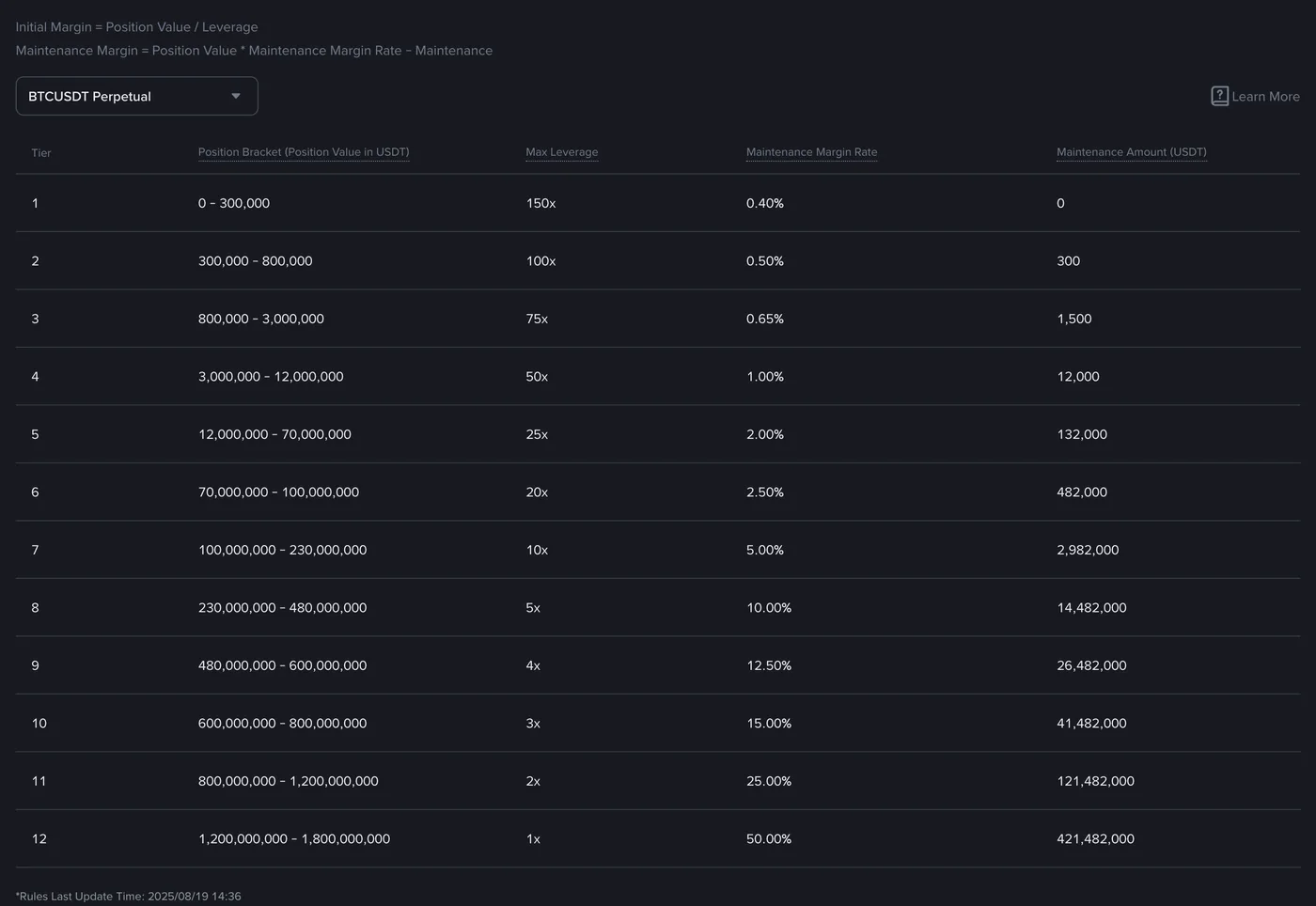
The 0.50% here is an example. Exchanges tier positions by notional, each tier with its own maintenance rate and amount; below is a screenshot of Binance's leverage and margin page for the BTCUSDT perpetual — the larger the position, the higher the rate and the closer liquidation.
Shorts are most exposed in a squeeze
A rally has no ceiling, and in a short squeeze the price can cover several percent in moments. The 1.44% of room on a 50x short can vanish in a single candle, and the gap between mark and last price can bring liquidation earlier than expected.
When the market leans short, funding is often negative and shorts pay at every settlement — margin slowly drained and the liquidation price edging down. The longer a short is held, the more that cost belongs in the calculation.
Checks before opening a short
Size the position from the stop first, then confirm the liquidation price sits beyond the stop with room for volatility. If the stop needs 5% of room, the 4.43% distance of a 20x short is structurally too tight.
Before ordering, check margin mode, maintenance tier, mark price and the estimated liquidation price in the exchange's order preview; if DZPTO's figure differs, the account is right.
Official sources and calculation boundary
The direction of a short's liquidation price and the definition of margin balance follow Binance's USDⓈ-M liquidation documentation and OKX's liquidation conditions. 0.50% and 0.05% are this site's standard example inputs; the real maintenance rate depends on the position tier, and liquidation triggers on the mark price.
- Binance: how to calculate the liquidation price of USDⓈ-M futures
- OKX: futures liquidation price and conditions
Next checks in this series
Frequently asked questions
Why is a short's liquidation distance shorter than a long's?
The short formula's denominator is (1 + r) and the long's (1 − r), so the same margin buys slightly less price room on a short: 9.40% for the 10x short here against 9.50% for the long.
How much does a liquidated short lose?
In isolated margin, at most the position's own margin — 1,000 USDT for the 10x short here. In cross margin, the account's available balance can be used to support the position.
Why doesn't leverage set a cross-margin short's liquidation price?
In cross margin the wallet balance supports the position, not its own margin; leverage only sets how much margin opening takes. With a 3,000 USDT wallet here, liquidation is 64,644.46 USDT.
Is a short liquidated on the last price or the mark price?
Exchanges use the mark price to decide liquidation, so a single trade cannot be used to trigger it. Mark and last price can diverge, so liquidation can arrive before the price on screen suggests.