
Direct answer
A funding rate is per interval, not an annual rate. At +0.01% every eight hours — three times a day, 1,095 times a year — the annualised figure is about 10.95%: a 10,000 USDT long held for a year pays 1,095.00 USDT. At +0.03% it is 32.85%, or 3,285.00 USDT. At 10x the margin is only 1,000 USDT, so a year of +0.01% funding costs more than the whole margin.
The result first
Assume a 10,000 USDT long held for a full year, with funding every eight hours — 365 days × 3 = 1,095 settlements — at a constant rate.
In the funding cost calculator, enter 10,000 USDT and 1,095 settlements: at +0.005% per interval a year costs 547.50 USDT; at +0.01%, 1,095.00 USDT; at +0.03%, 3,285.00 USDT. At −0.01% the direction flips and the long receives 1,095.00 USDT a year.
As annual percentages those are 5.475%, 10.95% and 32.85%. The calculator's cumulative rate is exactly every interval added up.
How to annualise
Annualised funding ≈ rate per interval × settlements per day × 365. An eight-hour interval settles three times a day, so 0.01% × 3 × 365 = 10.95%. A four-hour interval settles six times a day, making the same 0.01% 21.9%.
This is simple addition: every interval uses the same notional, ignores price changes that alter the position's value, and assumes nothing is reinvested. It is good for comparing magnitudes, not for exact returns or costs.
Held for 30 days (90 settlements) at +0.01%, the long pays 90.00 USDT, 0.9% of notional. Set that against the price return you expect over the same period to see how much funding weighs in the trade.
Rate per interval against annual figure
A 10,000 USDT long on an eight-hour interval held for a year (1,095 settlements). Every row reproduces in the funding cost calculator; with a negative rate the long is paid.
| Rate per interval | Per day (×3) | Annualised | A year's funding (USDT) | Multiple of 10x margin |
|---|---|---|---|---|
| +0.005% | 0.015% | 5.475% | pays 547.50 | 0.55× |
| +0.01% | 0.03% | 10.95% | pays 1,095.00 | 1.10× |
| +0.03% | 0.09% | 32.85% | pays 3,285.00 | 3.29× |
| −0.01% | −0.03% | −10.95% | receives 1,095.00 | — |
The conversion
Annualising only adds up the intervals; the calculator's cumulative rate is that sum. Multiply it by the notional for the funding over the hold.
Holding time and cost
At the same +0.01% on an eight-hour interval, 30 days costs 90.00 USDT and a year 1,095.00 USDT. Holding time is the variable that scales the cost linearly.
| Held | Settlements | Funding (USDT) | Share of notional |
|---|---|---|---|
| 30 days | 90 | 90.00 | 0.90% |
| 1 year | 1,095 | 1,095.00 | 10.95% |
What real rates look like
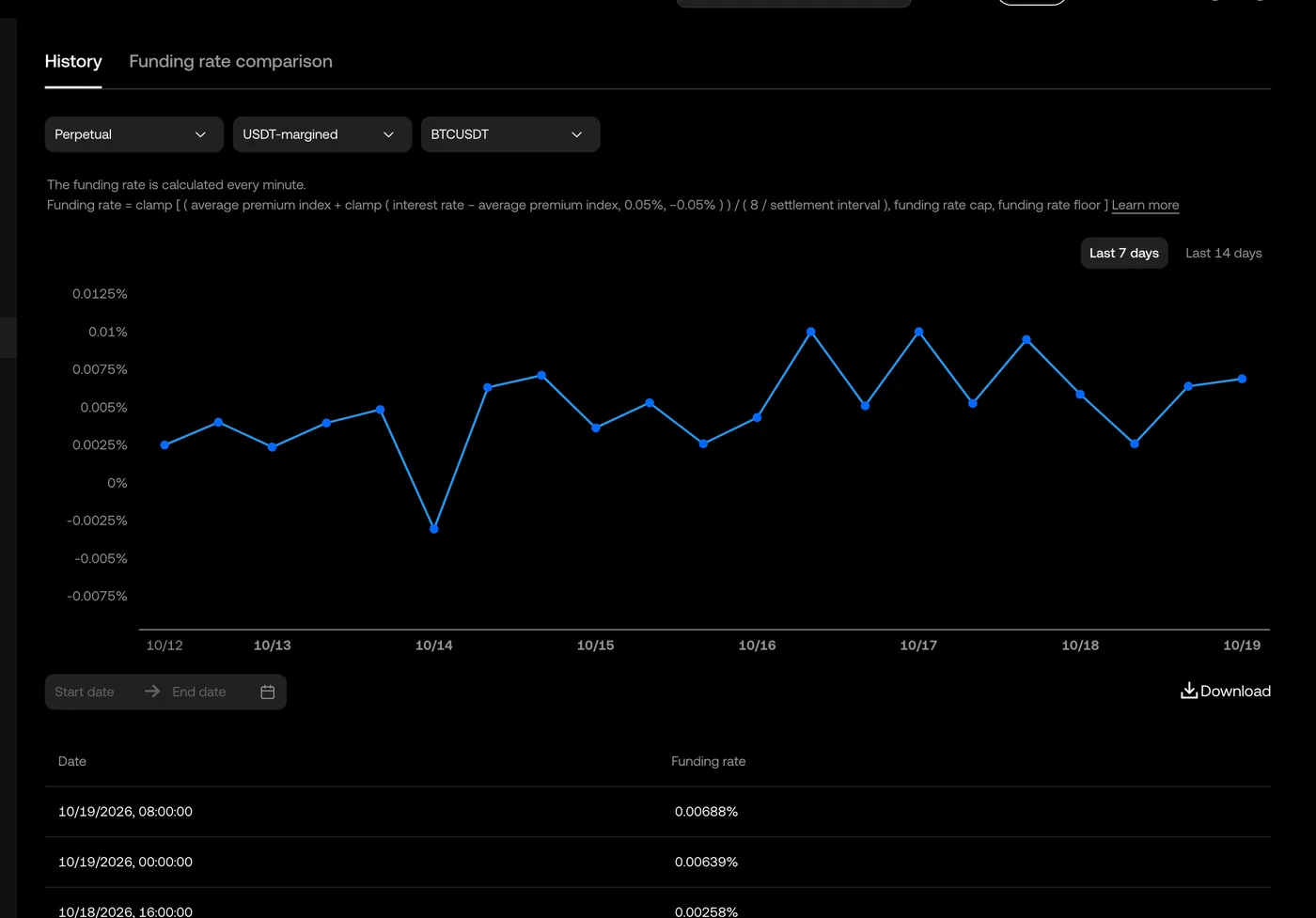
Annualising uses a fixed rate, but the real rate changes every interval. Below is a screenshot of OKX's funding history for the BTCUSDT perpetual: over seven days the rate moves up and down around zero and occasionally turns negative. Estimating from a record like this is closer to reality than assuming one fixed rate.
Against the margin it is starker
10.95% a year is relative to notional; against margin, multiply by the leverage. At 10x the margin is 1,000 USDT, and a year's 1,095.00 USDT of funding already exceeds the whole margin.
That is why long-held, high-leverage positions fear positive funding: even if the price stands still, the margin is slowly collected and the liquidation price drifts the wrong way.
What the annual figure is not
The rate changes every interval; today's 0.01% says nothing about tomorrow or next month. Annualising only shows what would happen if it held, which is no promise and cannot be compared directly with a deposit or savings rate.
To estimate a holding cost, look at recent actual settlements and multiply by the intervals you expect to hold; this site's coin funding pages list both exchanges' settlements over the past 30 days.
Official sources and calculation boundary
That funding passes between longs and shorts each interval follows Binance's funding introduction and OKX's funding FAQ. Annualising adds up a fixed rate on a fixed notional and does not predict future rates; real payments follow each settlement's rate and mark price.
Open the matching calculatorNext checks in this series
Frequently asked questions
Is 0.01% per day or per year?
Per interval. Most contracts settle every eight hours, so 0.01% is paid or received three times a day — about 10.95% a year.
Can an annualised funding rate be treated as a yield?
Not directly. The rate changes every interval, and the side receiving funding still carries the position's price risk; the annual figure only extends today's rate over a year.
Where does 10.95% a year come from?
0.01% per interval, every eight hours, three times a day, 365 days: 0.01% × 3 × 365 = 10.95%.
What does an annualised negative rate mean?
That longs are paid and shorts pay. At −0.01% for a year, a 10,000 USDT long receives 1,095.00 USDT — though the rate can turn positive at any time.