
Direct answer
At the same +0.01% per interval, a 10,000 USDT long held seven days pays 21.00 USDT when funding settles every eight hours; every four hours that is 42 settlements and 42.00 USDT; every hour, 168 settlements and 168.00 USDT. Check the interval before comparing: on a four-hour interval, +0.005% per interval costs the same 21.00 USDT over seven days as +0.01% on an eight-hour interval.
The result first
Assume a 10,000 USDT long held for seven days, at +0.01% every interval. In the funding cost calculator change only the number of settlements: an eight-hour interval gives 21 in seven days and costs 21.00 USDT; a four-hour interval gives 42 and costs 42.00 USDT; a one-hour interval gives 168 and costs 168.00 USDT.
Over a year the gap widens: 1,095 settlements and 1,095.00 USDT on an eight-hour interval, 2,190 and 2,190.00 USDT on a four-hour one.
The other way round: a four-hour contract at +0.005% per interval costs 21.00 USDT over seven days, the same as an eight-hour contract at +0.01%. Comparing only the displayed rate misjudges the cost by a factor of two.
Put them on one basis
To compare rates on different intervals, convert them to a daily or eight-hourly equivalent: daily rate = rate per interval × settlements per day. 0.01% every eight hours is 0.03% a day; 0.005% every four hours is also 0.03%.
Holding cost = notional × rate per interval × settlements, and settlements = hours held ÷ interval hours. With these two, rates on any interval fit in one table.
Exchanges' funding caps and floors are per interval as well. When the interval shortens, the same per-interval cap can be paid more times a day, so the cost of an extreme day grows too.
Same rate, different intervals
A 10,000 USDT long at +0.01% per interval: funding over seven days and a year, changing only the settlement interval.
| Interval | Per day | In 7 days | 7-day funding (USDT) | A year's funding (USDT) |
|---|---|---|---|---|
| 8 hours | 3 | 21 | 21.00 | 1,095.00 |
| 4 hours | 6 | 42 | 42.00 | 2,190.00 |
| 1 hour | 24 | 168 | 168.00 | — |
Compare on a daily rate
Rates on different intervals cannot be compared as shown. As daily rates, 0.005% every four hours and 0.01% every eight hours are both 0.03% a day, and both cost 21.00 USDT over seven days.
Where the interval is shown
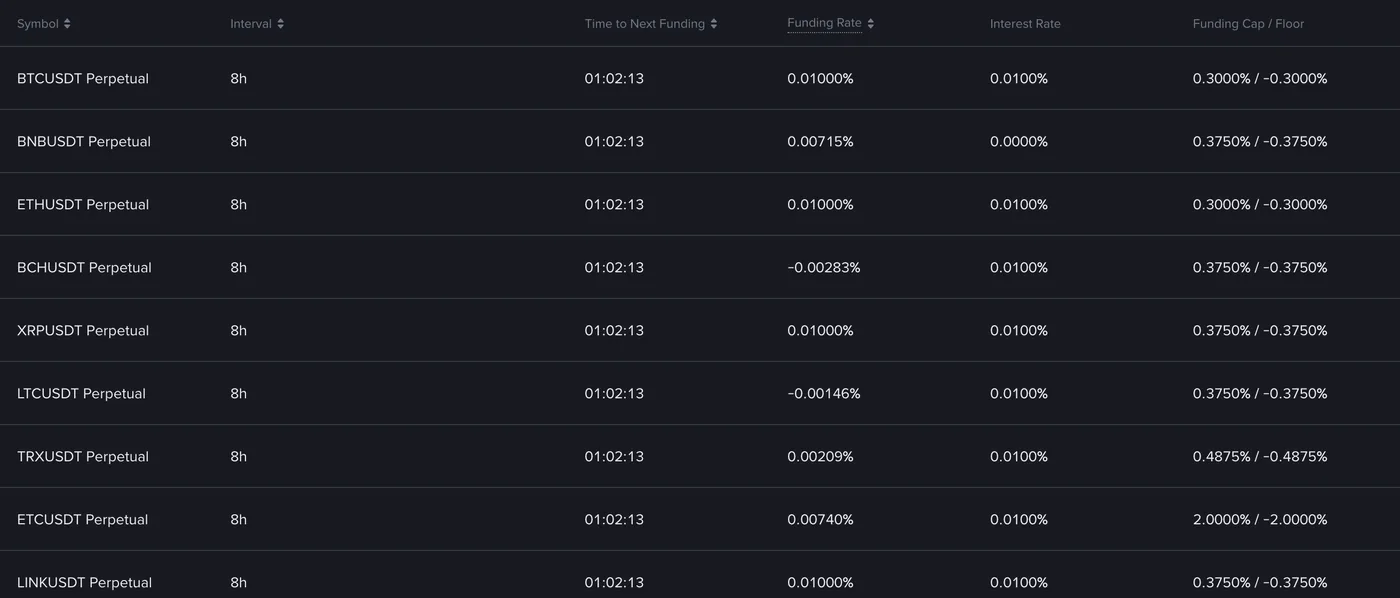
Below is a screenshot of Binance's real-time funding page: the interval column is each contract's settlement interval, next to the countdown to the next settlement and the contract's funding cap and floor. Read that column before comparing.
Caps apply per interval too
Funding caps and floors limit each interval. By the parameters recorded on this site, Binance's BTCUSDT cap is ±0.300% per interval: at most three settlements a day on an eight-hour interval, six on a four-hour one, so the cost of an extreme day grows with the interval count.
When an interval shortens, then, watch the worst case as well as the usual rate: the cap times settlements per day is the largest share that can change hands in a day.
Where to find the interval
An exchange's real-time funding page lists each contract's settlement interval and the time to the next settlement. Most major contracts settle every eight hours, but some use shorter intervals and exchanges can change them, so recheck before each comparison.
This site's coin funding pages list the settlement intervals and caps for BTC, ETH and SOL on Binance and OKX, with the date they were recorded.
Comparing two exchanges
Confirm both use the same interval before comparing rates; if they differ, convert to a daily rate first. Watch for interval changes while holding too: when the number of settlements changes, so does the cost.
The funding cost calculator takes a rate per interval and a number of settlements, so it works for any interval; run each exchange's figures separately and set them side by side.
Official sources and calculation boundary
That funding is paid at settlement, with rates and intervals set by the exchange, follows Binance's funding introduction and OKX's funding FAQ. BTCUSDT's ±0.300% cap per interval is recorded on this site's BTC funding page; intervals and caps can change, so the exchange's page applies.
Open the matching calculatorNext checks in this series
Frequently asked questions
Why do some contracts settle every four hours?
Exchanges set the interval per contract; some use shorter intervals, and exchanges can change them. The interval shown on the exchange's real-time funding page is the one that applies.
Is a shorter interval always worse for longs?
Not necessarily — it depends on the sign of the rate. With a positive rate longs pay more often; with a negative rate they are paid more often.
Can the interval change while I hold?
Exchanges can change an individual contract's interval; afterwards the same holding time crosses a different number of settlements, and the cost changes.
How do I enter different intervals in the calculator?
Enter the rate per interval as the exchange shows it, and the number of settlements as hours held divided by interval hours — 42 for seven days on a four-hour interval.