
Direct answer
Buying 0.2 BTC at 50,000 USDT and closing at 52,000 USDT seven days later (+4%, 10x, 0.05% taker fees) nets 389.80 USDT before funding. At a funding rate of +0.01% across 21 settlements the long pays 21.00 USDT and nets 368.80 USDT; at +0.05% it pays 105.00 USDT and nets only 284.80 USDT — more than a quarter of the price gain gone. Held 30 days at +0.03%, funding reaches 270.00 USDT and the net profit falls to 119.80 USDT.
The result first
Assume 0.2 BTC bought at 50,000 USDT (10,000 USDT of notional) at 10x, with taker fills at 0.05% on both trades, closed at 52,000 USDT after seven days. Funding settles every eight hours, 21 times in seven days.
The price move earns 400.00 USDT and fees cost 10.20 USDT. Without funding the trade nets 389.80 USDT; at +0.01% it pays 21.00 USDT and nets 368.80 USDT; at +0.03% it pays 63.00 USDT and nets 326.80 USDT; at +0.05% it pays 105.00 USDT and nets 284.80 USDT.
Enter the funding rate and 21 settlements in the futures PnL calculator to reproduce each case. With a negative rate the long is paid instead: at −0.01% the net profit becomes 410.80 USDT.
How funding enters the result
Each settlement's funding = position notional × that interval's rate; with a positive rate longs pay and shorts receive, with a negative rate the reverse. Funding over the hold is the sum of every interval.
This article uses a fixed rate: 10,000 × 0.01% × 21 = 21.00 USDT. In reality every interval has its own rate, and exchanges value the position at the mark price at each settlement, so this is an estimate of magnitude, not a bill.
Net PnL = price gain − opening fee − closing fee − funding. At +0.05%: 400.00 − 5.00 − 5.20 − 105.00 = 284.80 USDT. In this scenario funding is already ten times the fees.
Funding rate against net result
The same seven-day long up 4%: what it pays at each funding rate and what remains. With a negative rate the long is paid, so the last row nets more than the no-funding case.
| Funding rate (per 8 hours) | 7-day funding (USDT) | Net PnL (USDT) | ROE |
|---|---|---|---|
| 0 | 0.00 | 389.80 | +38.98% |
| +0.01% | pays 21.00 | 368.80 | +36.88% |
| +0.03% | pays 63.00 | 326.80 | +32.68% |
| +0.05% | pays 105.00 | 284.80 | +28.48% |
| −0.01% | receives 21.00 | 410.80 | +41.08% |
The longer the hold, the wider the gap
A fixed 4% rise with 0.05% taker fees, varying only the hold and the rate. Fourteen days (42 settlements) at +0.01% cost 42.00 USDT and net 347.80 USDT; thirty days (90) at +0.03% cost 270.00 USDT and net only 119.80 USDT — under a third of the no-funding result.
| Held | Settlements | Funding rate | Funding (USDT) | Net PnL (USDT) |
|---|---|---|---|---|
| 7 days | 21 | +0.01% | 21.00 | 368.80 |
| 14 days | 42 | +0.01% | 42.00 | 347.80 |
| 30 days | 90 | +0.01% | 90.00 | 299.80 |
| 30 days | 90 | +0.03% | 270.00 | 119.80 |
The other side: a short
Turn the scenario into a short: 0.2 BTC shorted at 50,000 USDT and closed at 48,000 USDT after seven days. At +0.01% the short receives 21.00 USDT and nets 411.20 USDT; at −0.03% it pays 63.00 USDT and nets 327.20 USDT.
Funding is always paid by one side to the other. A high rate means the paying side is crowded; which side you are on decides whether it is a cost or an income.
Where to see the current rate
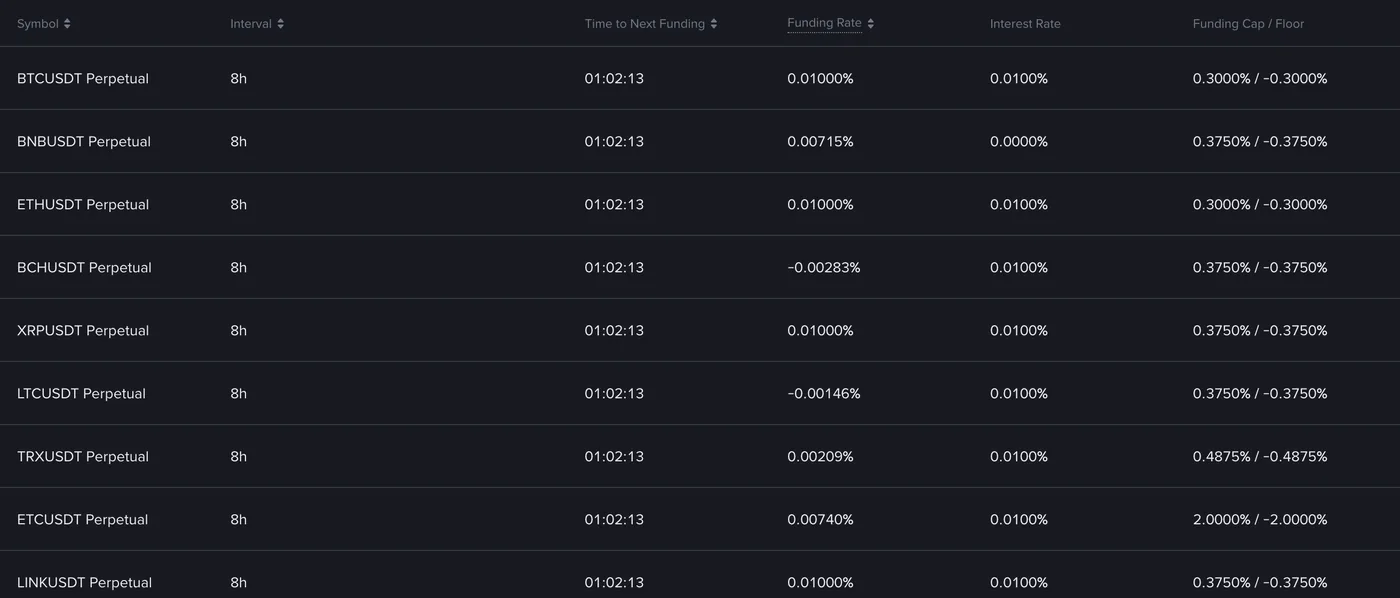
An exchange's real-time funding page lists each contract's current predicted rate, settlement interval and time to the next settlement. Below is a screenshot of Binance's real-time funding page; the predicted rate keeps moving until settlement, so the screenshot shows where the fields are and how to read them.
When funding gets expensive
In a one-way rally with many traders chasing longs, funding often stays at a high positive rate. Longs then pay every eight hours, and the longer the hold, the more it resembles rent: if the price stops rising, the profit on screen is slowly collected away.
Stretch the hold to 30 days (90 settlements) and +0.01% costs 90.00 USDT, leaving 299.80 USDT; +0.03% costs 270.00 USDT, leaving only 119.80 USDT. On the same 4% move, holding longer at a higher rate cuts what you keep by more than two thirds.
Checks before holding
Before opening, check the current funding rate and its recent path, then count how many settlements the planned hold will cross. If the rate has stayed high, consider a shorter hold, a smaller position, or a delivery future or spot, which carry no funding.
While holding, the rate can change sign at any time. Treat it as a moving cost: every few days, recalculate with the latest rate and confirm the remaining expected profit still covers it.
Official sources and calculation boundary
That funding passes between longs and shorts and is computed only at settlement follows OKX's funding FAQ and Binance's funding introduction. This article estimates with a fixed rate on the opening notional; real rates differ every interval and are charged on the mark price at settlement. The 0.05% taker rate is a Regular User example.
Open the matching calculatorNext checks in this series
Frequently asked questions
Does the exchange collect funding?
No. Funding passes directly between longs and shorts and the exchange takes no cut; it is separate from trading fees.
If I close before settlement, do I avoid funding?
Yes — funding is computed only at the settlement time. Close before it and that interval neither pays nor receives; a new position that spans a settlement still counts.
How many funding settlements are in 7 days?
With settlement every eight hours, three a day and 21 in seven days. Some contracts settle every four hours or every hour, which multiplies the count; check the exchange's page.
Is funding charged on the entry price or the price at settlement?
Exchanges value the position at the mark price at each settlement; this article estimates on the opening notional, which differs when the price moves a lot.