
Direct answer
A round trip on a 10,000 USDT futures position costs 10.00 USDT with 0.05% taker fees and 4.00 USDT with 0.02% maker fees. Five round trips a day over 20 trading days adds up to 1,000 USDT of taker fees, or 400 USDT as maker. Against the 1,000 USDT margin of a 10x position, a month of taker fees equals the entire margin.
The result first
Assume each trade opens a 10,000 USDT position and closes it the same day without crossing a funding settlement. In the trade cost calculator, enter 10,000 USDT of notional and zero settlements: with taker fees of 0.05% on both trades a round trip costs 10.00 USDT; with maker fees of 0.02%, 4.00 USDT; opening as maker and closing as taker, 7.00 USDT.
Five round trips a day: 50 USDT as taker, 20 USDT as maker. Over a month of 20 trading days: 1,000 USDT taker, 400 USDT maker, 700 USDT mixed.
Paying Binance fees in BNB for 10% off brings a taker round trip to 9.00 USDT, or 900 USDT a month. The discount helps, but the number of trades is what decides the total.
How fees accumulate
Each round trip's fee = notional × (opening rate + closing rate): 10,000 × (0.05% + 0.05%) = 10 USDT. Fees follow the notional and have nothing to do with the leverage used.
A month's fees = fee per round trip × trades per day × trading days. It adds up linearly: twice the trades, twice the fees.
In terms of required profit, every round trip must move about 0.10% in your favour (taker) or 0.04% (maker) just to cover fees. Five a day means earning an extra 0.5% of notional each day before making any real profit.
Order type against a month of fees
10,000 USDT each time, five round trips a day, 20 trading days a month. The single round trip reproduces in the trade cost calculator; the monthly figure multiplies by the count.
| Open / close | Round trip (USDT) | 5 a day (USDT) | A month (USDT) | Share of 10x margin |
|---|---|---|---|---|
| Taker/taker 0.05% | 10.00 | 50 | 1,000 | 100% |
| BNB 10% off 0.045% | 9.00 | 45 | 900 | 90% |
| Maker/taker | 7.00 | 35 | 700 | 70% |
| Maker/maker 0.02% | 4.00 | 20 | 400 | 40% |
What each trade must earn first
Each round trip's fee is distance the price must cover first: about 0.10% as taker, 0.04% as maker. The more often you trade, the more of that distance accumulates.
How frequency matters
At a fixed 0.05% taker rate and 10,000 USDT per trade, monthly fees rise linearly with daily trades: 200 USDT at one a day, 1,000 at five, 2,000 at ten.
At 10x, ten taker round trips a day cost twice the margin in a month. Trading less often usually does more than chasing a fee discount.
| Round trips a day | A month's fees (USDT) | Share of 1,000 USDT margin |
|---|---|---|
| 1 | 200 | 20% |
| 5 | 1,000 | 100% |
| 10 | 2,000 | 200% |
Where the fee table is
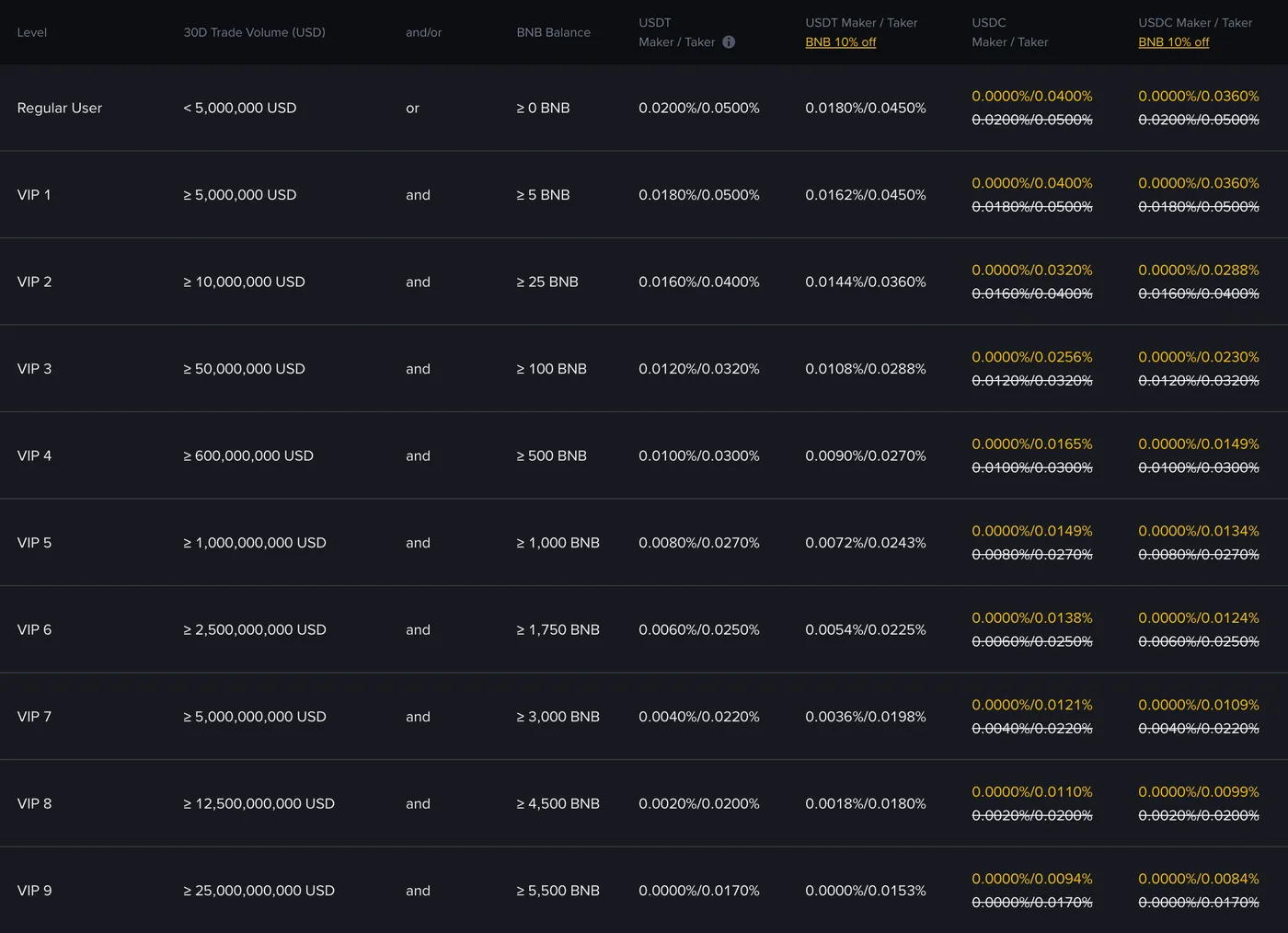
Maker and taker rates depend on tier. Below is a screenshot of Binance's USDⓈ-M futures fee page: Regular User USDT contracts pay 0.0200%/0.0500%, with the BNB-discounted rate beside it; higher VIP tiers pay less.
Against the margin
At 10x, a 10,000 USDT position needs only 1,000 USDT of margin. A month of all-taker fees at 1,000 USDT pays the whole margin away once a month; maker fees still take four tenths of it.
That is why high-frequency trading demands such a high win rate: it is not enough to call direction; every trade's gain must clear a fixed fee hurdle.
Practical ways to cut fees
First, use maker orders where you can: here that cuts a round trip from 10.00 to 4.00 USDT, 60% less. Second, trade less, concentrating on the setups you trust most. Third, confirm your fee tier and any platform-token discount, and recalculate with your real rate.
Each exchange's fee page lists maker and taker rates by tier; before trading, enter your rates in the trade cost calculator for the cost of one round trip and multiply by how often you actually trade.
Official sources and calculation boundary
Fees on executed notional, independent of leverage, follow Binance's and OKX's fee documentation; the 10% BNB discount follows Binance's fee page. 0.05% and 0.02% are Regular User example rates, and the monthly totals assume five round trips a day over 20 trading days.
Open the matching calculatorNext checks in this series
Frequently asked questions
If a day trade never crosses settlement, are fees the only cost?
In this article's scenario, yes; but market orders also carry slippage, and in fast markets the gap between expected and actual fill is a cost too.
Does higher leverage reduce fees?
No. Fees are charged on notional, so the same 10,000 USDT position pays the same fees at 10x or 50x.
Shouldn't fees be built into each take-profit and stop?
They should. The futures PnL calculator's break-even price already includes opening and closing fees; check that each take-profit sits beyond it.
Can a month's 1,000 USDT of fees be rebated?
Some exchanges have rebate or discount schemes under their own terms; this article counts the cost at standard rates.